One in five cases closed at first touch.
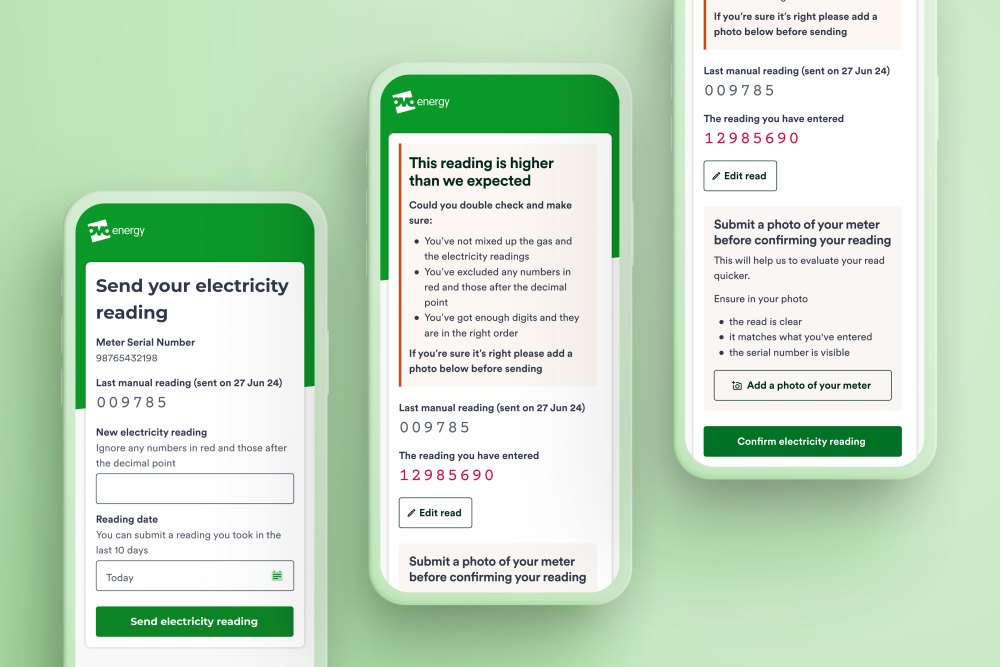
Letting customers add a photo of their meter when a reading looks wrong, so agents no longer have to email and ask for one.
Page summary
- Surprising meter reads raised 319k exceptions a year, and fixing each one started with an email chase that could take two weeks.
- We asked for the photo at the moment the customer submits the read, and built the service behind it so nothing blocked the release.
- 35% of prompted customers attach one, exceptions resolve in a day instead of a fortnight, and the projected saving is 7.4 full time agents a year.
The problem.
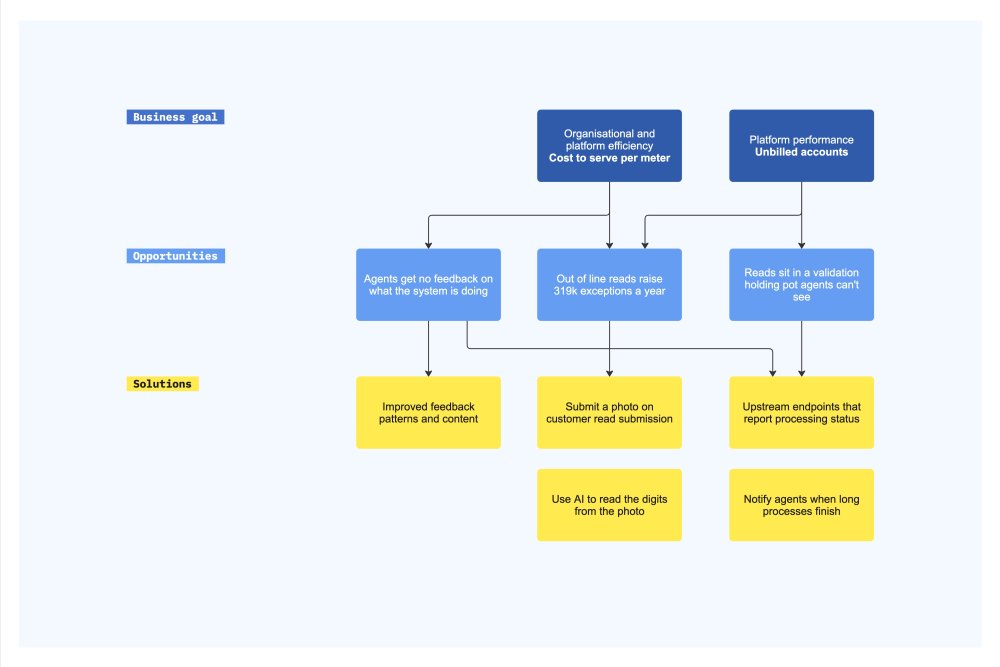
Kaluza is an energy platform used by OVO and other suppliers. When a customer submits a meter reading that looks wrong the platform can't bill against it. It raises an exception for a back office agent to investigate, and over twelve months these added up to 319k, 7.3% of all billing exceptions.
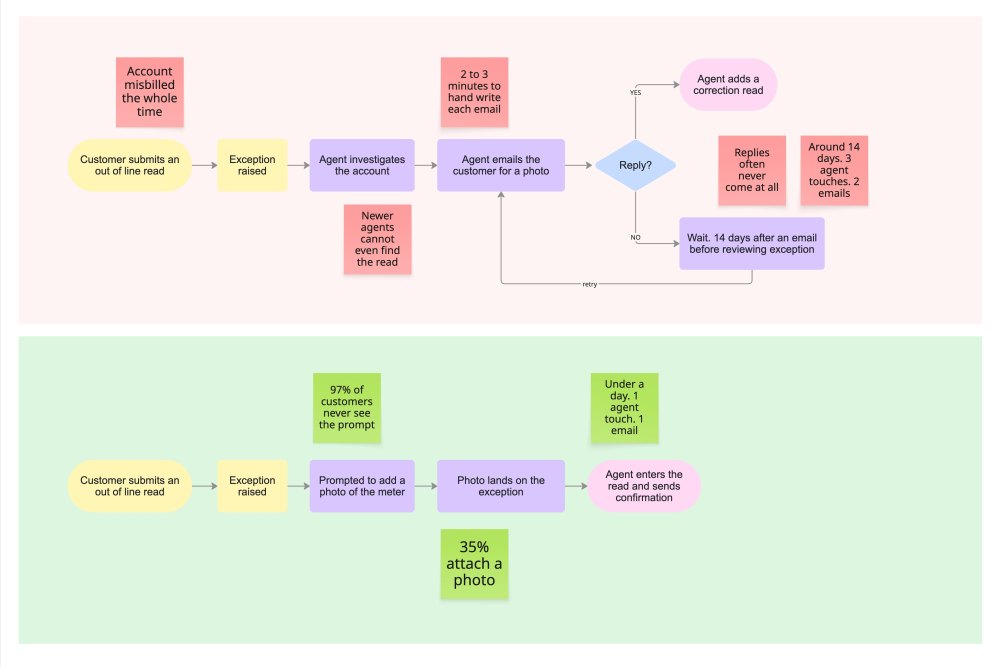
Nearly every one started the same way. The agent emails the customer asking for a photo of the meter, then everyone waits. Seven days allowed for an email reply, fourteen for a letter, often no reply at all, and the account sat incorrectly billed the whole time.
“We have to hand write an email to say I need a picture of your meter… it's a bit time consuming.”
Account health agent, OVOAround 14 days, three agent touches and two emails per exception. With the photo arriving alongside the read, under a day and one touch.
What we did.
When a customer submits a read they're usually still standing at the meter with their phone in hand. So we asked for the photo right there, inside the journey that already existed, rather than days later by email.
“Out of line, the best starting point you could ever get is a photo.”
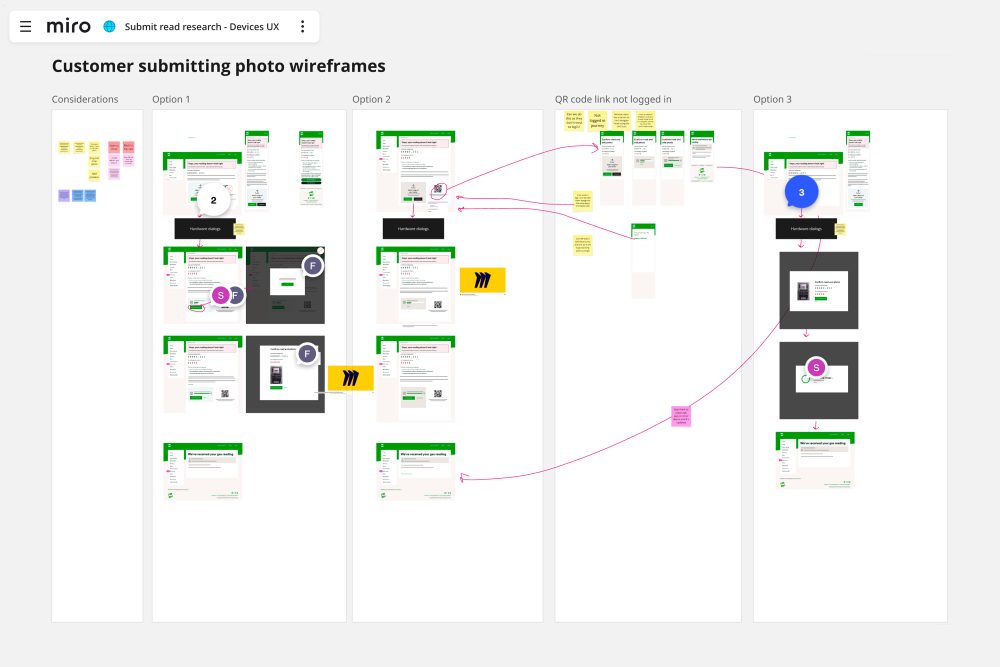
Account health agent, OVOThe problem surfaced through the research practice I built, weekly agent sessions running since 2021, mapped onto an opportunity solution tree that hangs off the company's goals. One billing ops agent called the fix before we'd designed anything. We explored and dropped a QR code handoff to the phone camera, parked for complexity, and making the photo mandatory, dropped for a better reason. Sometimes an out of line read is legitimate, and we weren't going to block a genuine reading because the system found it surprising. What stayed was lean. One prompt in the existing flow, shown only when a read fails validation, so 97% of customers never see it.
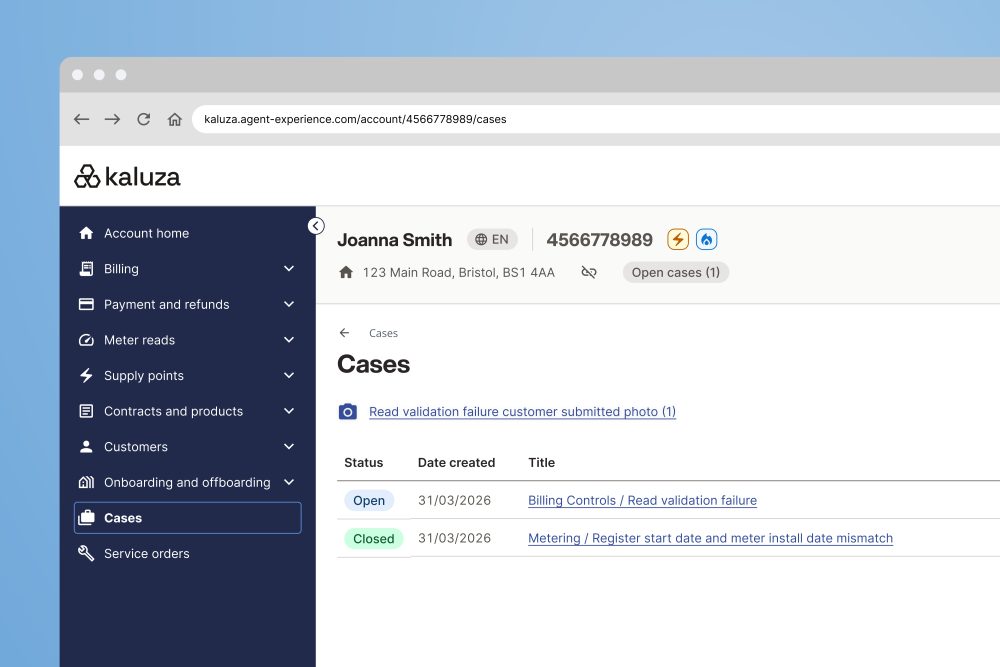
Kaluza is a platform, so shipping took more than screens. We built a small new photo service behind our API rather than wait on other teams, proved the customer side in the component explorer, put the agent side behind a feature flag, and used the working end to end demo to get OVO to prioritise the release. On the agent side the photo sits on the exception itself. Open the case, open the image, enter the read, send the confirmation.
The work also kept confirming a bigger problem already on the tree, that agents get almost no feedback on what the system is doing, around 375 hours a week of waiting and refreshing across OVO UK. I made the case for a dedicated week on it, which became its own case study, A week on feedback.
Measuring it.
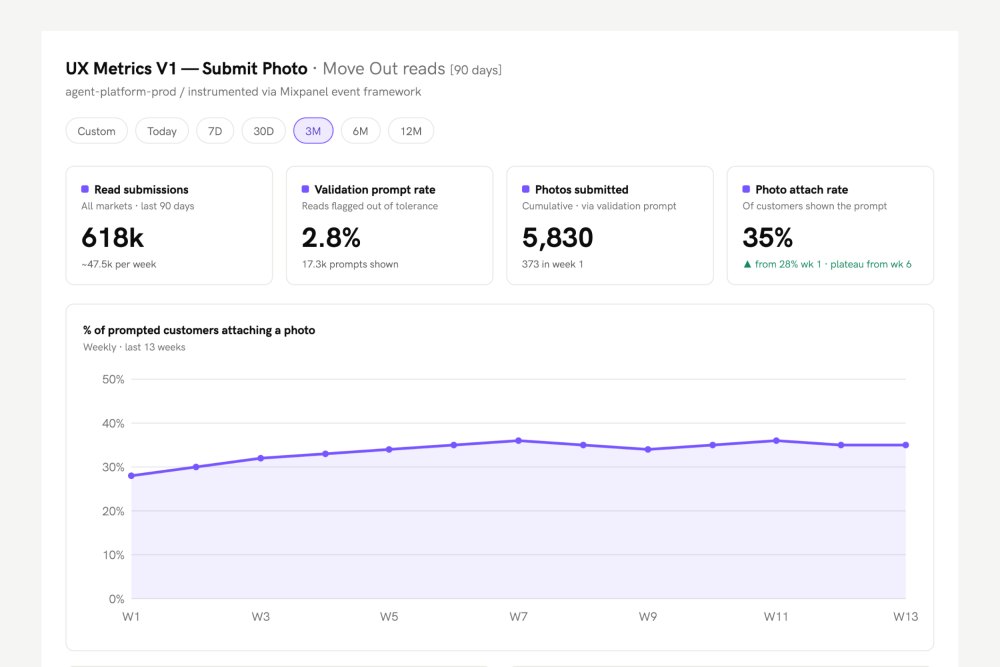
I defined the metrics before anything was built. Saving 2 to 3 minutes per exception works out at 7.4 full time agents a year, and every interaction ships tracked in Mixpanel against the event naming convention I'd defined for the team. Ninety days in, the attach rate held around 35%, and about a fifth of photos still couldn't be used, which is exactly where the next iteration points.
What happened.
In the first week 373 customers attached a photo, 28% of everyone shown the prompt, settling around 35% over the following weeks, with no announcement or promotion at all. Agents found it on their own and started resolving exceptions at first touch. We looked into reading the digits straight from the photo, which would remove the manual entry step altogether, and parked it honestly, a lot of effort for the payoff right now. But none of it is possible without the photos existing in the first place.
“It would be helpful rather than having to go and email or even send a letter… it would be handy if we had all the information there already.”
Billing ops agent, research session, before we'd designed anything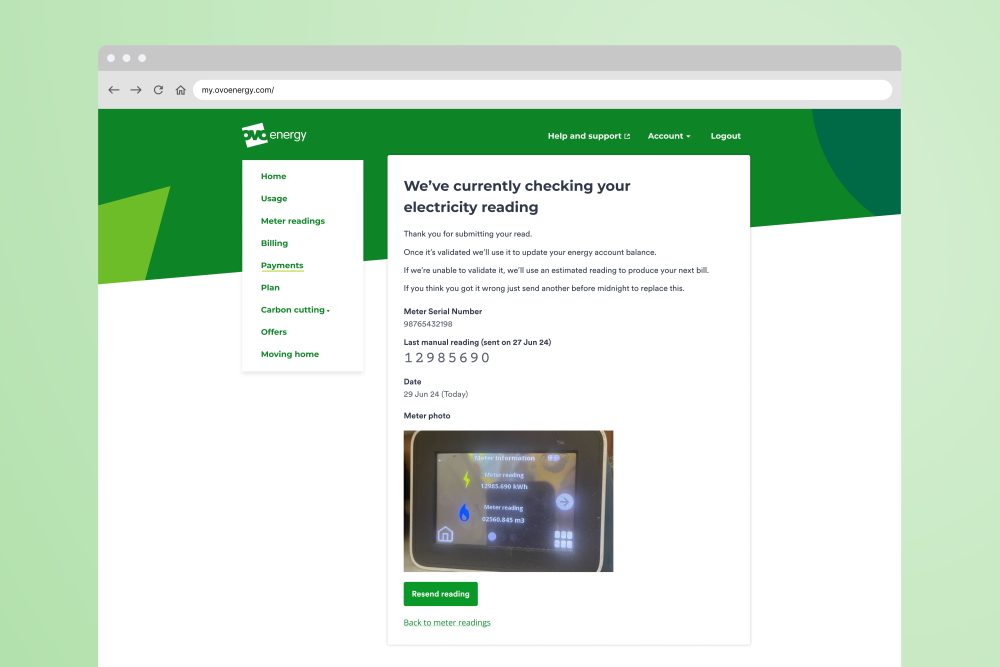
Learnings.
- We didn't build a new tool. We asked an existing question at the moment the customer could actually answer it, and that was the whole fix.
- Agreeing the numbers before the build made design decisions easier to settle. We could point at what we were trying to change rather than debate preferences.
- Sometimes the system is wrong and the customer is right. Not blocking a genuine read mattered more than a tidier photo rate.